Saturday, March 17, 2012

Evolution Blog

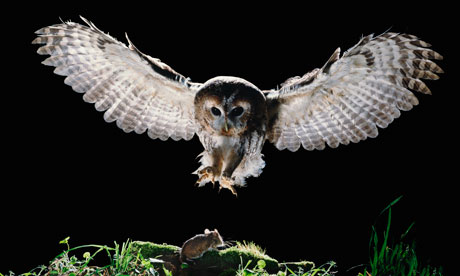
Some traits are advantagious or detrimental, depending on the environment. It's easy for an owl to spot a white mouse sitting on a dark rock. But it's very hard for an owl to spot a white mouse in the snow. 
      

Blog( becoming human)


Found:2001
Where:Toros-Manalla site 266, Chad
Team leader(s):Michel Brunet, Alain Beayvilain
Temporal range:7 to 6 million years ago

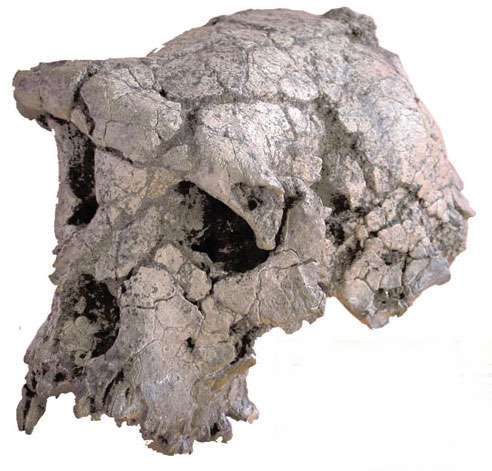
Sahelanthropus tchadensis was described in 2002 by French paleontologist Michel Brunet and his team.  It was discovered in Chad from deposits that have been dated by biostratigraphy to between 6 and 7 million years in age.  Central Africa is an unusual place to find hominid fossils, and the conditions under which these paleontological teams work are arduous.  Their efforts are invaluable for documenting the geographic spread of hominids across the African continent.  Many fossils of other animals were recovered at the same site asSahelanthropus, suggesting that the habitat, a dry desert today, was then a lush lakeshore with extensive forests around it. 


http://www.becominghuman.org/node/sahelanthropus-tchadensis


Found:October 2000
Where:Tugen Hills, Kenya
Team leader(s):Martin Pickford, Brigitte Senut
Temporal range:6.1 to 5.8 million years ago


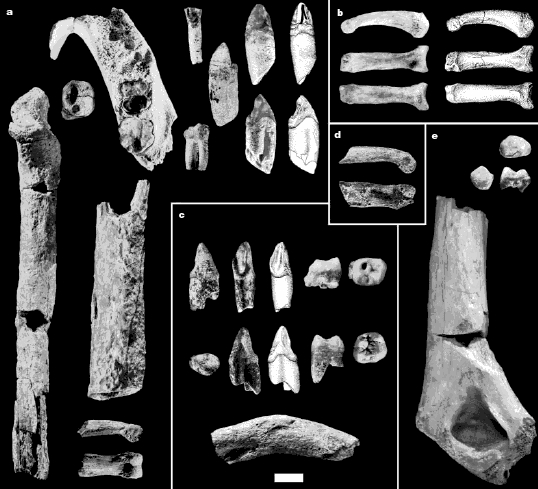
Orrorin tugenensis is represented by a collection of fossils from the Tugen Hills region of Kenya.  Specifically, O. tugenensis is known from four sites in this region: Cheboit, Kapsomin, Kapcheberek, and Aragai.  “Orrorin” means “original man” in the Tugen dialect, and “tugenensis” pays tribute to the Tugen Hills region.  The sediments in which this specimens have been found are dated to between 6 and 5.8 million years ago using radioisotopic methods, paleomagnetism (dating accomplished using the timing of reversals in Earth’s magnetic poles), and biochronology (dating that utilizes the relative time frames of extinct non-hominin animals).  Orrorin tugenensis is important to hominin evolution because it (along with Sahelanthropus tchadensis, from central Africa) may represent some of the earliest evidence for bipedalism in the human fossil record.
http://www.public.wsu.edu/gened/learn-modules/top_longfor/timeline/05_o_tugenensis.html


Found:1997
Where:Middle Awash, Ethiopia
Team leader(s):Tim White, Gen Suwa, Yohannes Haile Selassie
Temporal range:5.7 to 5.2 million years ago

Ardipithecus kadabba is an early hominin species recovered from sediments in the Middle Awash Valley of Ethiopia dated to between 5.2 and 5.8 million years ago.  These fossils are of particular importance because fragments from both the skull and body have been found and are argued to demonstrate some of the earliest signs of bipedalism and hominin dental morphology.  As one of the oldest species of human ancestors, Ar. kadabbahelps to push back the origin of hominins into the late Miocene Epoch (roughly 11.6 to 5.3 million years ago). 
http://dhistorika.blogspot.com/2011/11/ardipithecus-kadabba-un-chimpance.html


Found:December 1992
Where:Aramis,  Ethiopia
Team leader(s):Tim White
Temporal range:
4.5 to 4.2 million years ago
Ardipithecus ramidus is a hominin species  dating to between 4.5 and 4.2 million years ago (mya) using paleomagnetic and radioisotopic dating methods. (Paleomagnetic uses periodic reversals in the Earth’s magnetic field; radioisotopic utilizes the known rate of decay of one radioisotope into another)  Importantly, Ar. ramidusrepresents the oldest species that possesses features unequivocally linked to the hominin lineage.  Thus, Ar. ramidus is the best evidence discovered thus far for the root of the hominin family tree.  Fossils of this species, found in the Middle Awash region and the site of Gona in Ethiopia, possess derived features (features different from those found in the ancestor) in the skull and teeth.  The postcranial skeleton of Ar. ramidus, however, suggests  this species had not evolved obligate bipedality ("obligate" means the skeletal anatomy limits locomotion to one means, in this case bipedality. Obligate is the oppodite of functional bibedality, possessed by Chimpamzees - Pan troglodytes - for example, who can walk upright for short distances or climb in trees).  This combination of traits is important because scientists have long considered obligate bipedality to be a defining characteristic of the hominin lineage.  The traits possessed by Ar. ramidus, however, demonstrate that hominin-like skulls and teeth evolved before obligate bipedality and suggest the earliest hominins were not obligate bipeds. 

http://berkeley.edu/news/media/releases/2004/03/04_Akadab.shtml


Found:September 1994
Where:Kanapoi and Allia Bay, Kenya
Team leader(s):Meave Leakey, Alan Walker
Temporal range:4.1 to 3.9 million years ago

Fossils attributed to Australopithecus anamensis (which means “southern ape of the lake” from “anam,” meaning “lake” in the Turkana language) have been recovered from sediments at Kanapoi and Allia Bay near Lake Turkana in Kenya.  These fossils, which have been dated to between 4.2 and 3.9 million years ago using radioisotopic dating methods applied to volcanic sediments, are significant because they represent the earliest indisputable evidence of obligate bipedality in the human fossil record.  In addition, the morphology of the skull of Au. anamensis provides a glimpse of the evolutionary changes that represent the transition from earlier, more primitive (i.e., ape-like) hominins—such as Ardipithecus ramidus—to later, more derived (i.e., human-like) species—such as Australopithecus afarensis. 
https://www.msu.edu/~heslipst/contents/ANP440/anamensis.htm

Bow 5

The Jurassic is a geologic period and system that extends from about 199.6± 0.6 Mya (million years ago) to 145.5± 4 Mya, that is, from the end of the Triassic to the beginning of the Cretaceous. The Jurassic constitutes the middle period of the Mesozoic era, also known as the age of reptiles. The start of the period is marked by the major Triassic–Jurassic extinction event. However, the end of the period did not witness any major extinction event. The Jurassic is named after the Jura Mountains within the European Alps, where limestone strata from the period was first identified. By the beginning of the Jurassic, the supercontinent Pangaea had begun rifting into two landmasses, Laurasia to the north andGondwana to the south. This created more coastlines and shifted the continental climate from dry to humid, and many of the arid deserts of the Triassic were replaced by lush rainforests. Dinosaurs dominated the land, and reached their peak in this period as they diversified into a wide variety of groups. The first birds also appeared during the Jurassic, having evolved from a branch of theropod dinosaurs. The oceans were inhabited by marine reptiles such as ichthyosaurs and plesiosaurs, while pterosaurs were the dominant flying vertebrates.Mammals also existed during this time; however, overshadowed by the dinosaurs, they constituted only a small and relatively insignificant part of the biosphere .http://en.wikipedia.org/wiki/Jurassic
http://en.wikipedia.org/wiki/File:MakhteshGadolCenter02.jpg


Bow 4

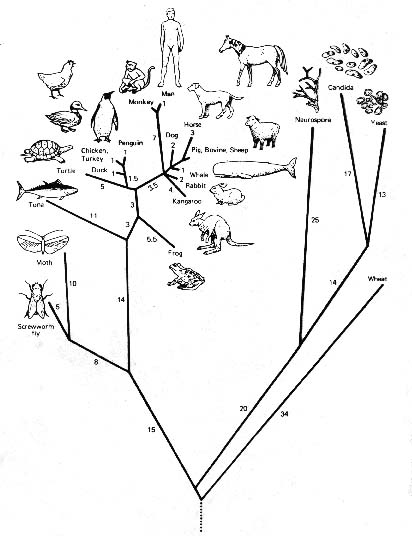
Natural selection is the gradual, nonrandom process by which biological traits become either more or less common in a population as a function of differential reproduction of their bearers. It is a key mechanism of evolution. 
        http://www.globalchange.umich.edu/globalchange1/current/lectures/selection/selection.html

Thursday, February 23, 2012

Bow 3

   what is natural selection?
          Natural Selection is a process by which become either more or less common in a function of differential reproduction of their bearers. The mutations do occur to produce brand new alleles that improve organisms chances of survival in a particular environment. Natural selection never affects the genotypes since it is already fixed the genotype combination can never be altered.
          
How does it relate to mutations, genotypes and phenotypes?

             The distinction between phenotype and genotype is fundamental to the understanding of heredity and development of organisms. The genotype of an organism is the class to which that organism belongs as determined by the description of the actual physical material made up of DNA that was passed to the organism by its parents at the organism's conception. For sexually reproducing organisms that physical material consists of the DNA contributed to the fertilized egg by the sperm and egg of its two parents. For asexually reproducing organisms, for example bacteria, the inherited material is a direct copy of the DNA of its parent. The phenotype of an organism is the class to which that organism belongs as determined by the description of the physical and behavioral characteristics of the organism, for example its size and shape, its metabolic activities and its pattern of movement.


    What is expatation?
           a looking forward to; anticipation; a looking for as due, proper, or necessary; a thing looked forward to. The act or the state of expecting.


Bow 2

Non-sense mutation: Three codons tell the cell to stop providing amino acids to the protein which supposely has been reached. when this happens the process is cut short and therefore it is an incompleted process. A disease caused by this is Cystic fibrosiss.
    INSERTION: occur when extra DNA is added into an existing gene
FRAMESHIFT:
   mutations result from either addition or deletion of one or two nucleotide bases. When this occurs the reading frame is changed so that all the codons read after the mutation are incorrect, even though the bases themselves may be still present.
      
POINT MUTATIONS: are small changes often in a single nucleotide base.


TRANSLOCATIONS: are the transfer of a piece of one chromosome to a nonhomolougus chromosomes. Translocations are often reciprocal; that is, the two nonhomologues swap 

  • the break may occur within a gene destroying its function
  • translocated genes may come under the influence of different promoters and enhancers so that their expression is altered. 
  • the breakpoint may occur within a gene creating a hybrid gene. This may be transcribed and translated into a protein with an N-terminal of one normal cell protein coupled to the C-terminal of another. The Philadelphia chromosome found so often in the leukemic cells of patients with  (CML) is the result of a translocation which produces a compound gene (bcr-abl). 

SENSE MUTATIONS:A mutation that changes a termination  codon into one that codes for an amino acid. Such a mutation results in an elongated protein. 
   DELETION MUTATIONS: result in missing DNA are called deletions. These can be small, such as the removal of just one "word," or longer deletions that affect a large number of genes on the chromosome. Deletions can also cause frameshift mutations. In this example, the deletion eliminated the word cat.


Tuesday, February 21, 2012

Bow 1

Transcription-It is the process of transcribing or making a copy of genetic  information stored in a DNA strand into acomplementary strand of RNA NA or mRNA) with the aid of RNA polymerases.

 Translation-  change or conversion  to another form, appearance, etc.;transformation.A step in protein biosynthesis wherein the genetic code carried by mRNA is decoded to produce the specific sequence of amino acids in a polypeptide chain. The process follows transcription in which the DNA sequence is copied (or transcribed) into an mRNA.